
An Odoo consultant’s customer does not buy a clever connector. They buy confidence that orders, invoices, projects, and customer information will keep moving without an expensive surprise.
An MSP’s customer is not asking for another dashboard full of warnings. They want the business to work, their information kept in the right hands, and someone accountable when a change goes wrong.
That is where I see a useful service opportunity: AI-assisted code review, backed by enforceable guardrails and a human decision funnel. Not “the AI says it’s safe.” A practical way to find possible problems, check what matters, and put the right decision in front of the right person.
Your customer’s pain is not a code problem—until it becomes one
If you run an owner-led Odoo practice, MSP, or small implementation team, your senior people probably sit between two pressures: customers want more useful automation, and somebody still has to understand the consequences.
The customer describes those consequences in business language:
- “Can that assistant see information this employee should not see?”
- “Will a small customization break the process we already depend on?”
- “Who approves a change that deletes or overwrites something?”
- “Will we find out about a problem before users complain?”
- “If it fails, who can explain what happened and get us back?”
For the partner, those questions can become unplanned investigation, support work, and another interruption for the one person who knows the integration. A raw AI report does not solve that. It can simply create a longer reading list.
The value is in connecting a finding to the customer’s workflow, a clear owner, and a controlled next step.
What this NoodleNet review actually shows
The screenshot below is from NoodleNet Pro’s Noodle IDE, reviewing an Odoo Gateway Chat application. Its first useful statement is that the review was advisory: the source was not changed, and no automatic fixes or deployment occurred.
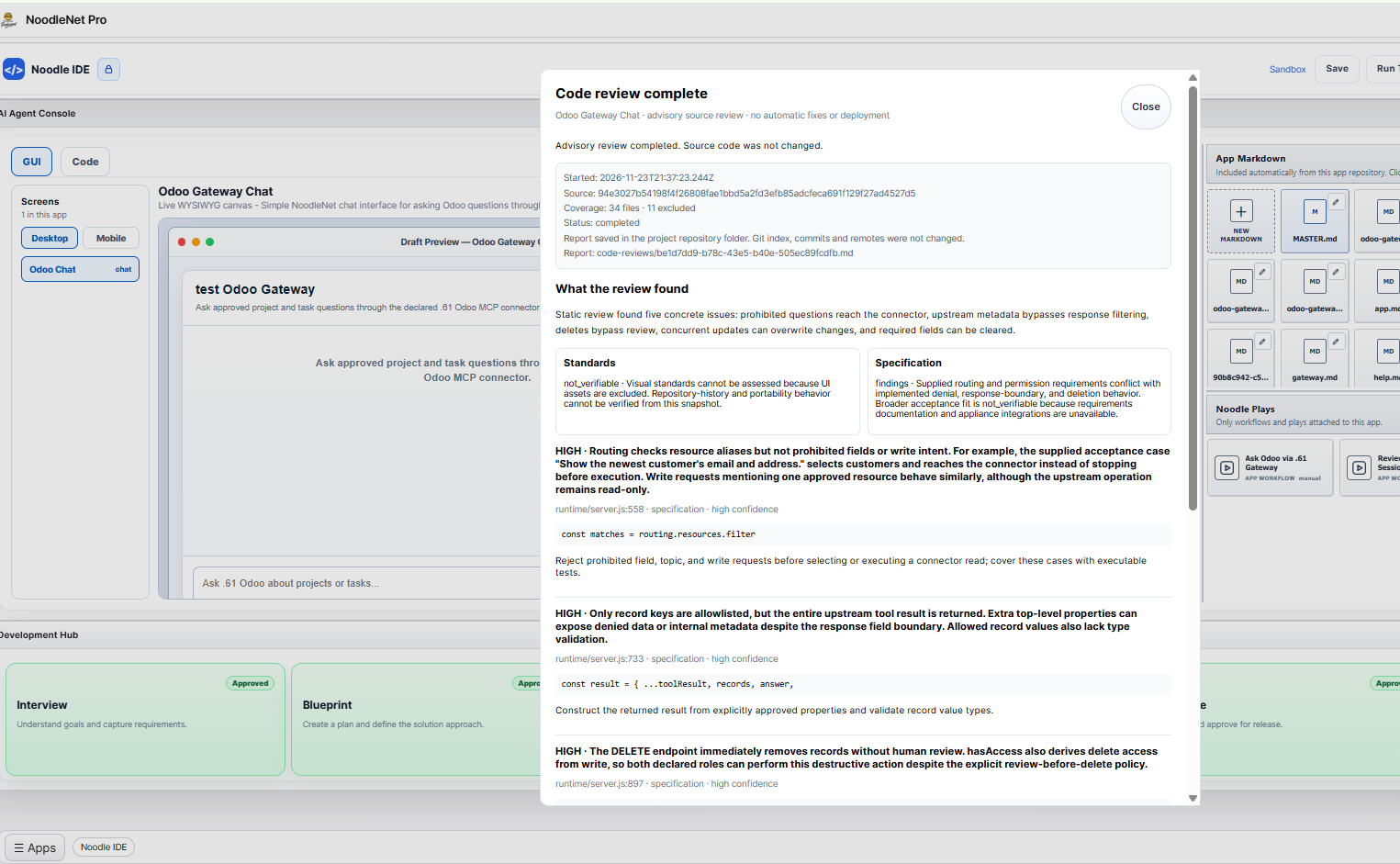
The supplied screenshot shows one completed source review—not continuous monitoring, a security certification, or proof that the reported issues were reproduced or fixed. Open the image to inspect the report.
The report says it covered 34 files and excluded 11. It flags five candidate issues: requests outside the intended scope reaching the connector, extra response data escaping the intended filter, deletion without the required review, concurrent updates overwriting work, and required fields being cleared.
Those are review findings, not established customer incidents. A human still needs to check the code, reproduce the relevant behavior, and decide what is actually wrong. The report also names things it could not verify, including visual standards and broader acceptance behavior.
That distinction is part of the value. A review that admits its limits is more useful than a green badge that suggests somebody checked everything.
The Odoo consultant’s opportunity: protect the workflow, not just the integration
Imagine an assistant intended to answer approved project and task questions. A customer request asks for information outside that purpose. The connector may be read-only, but reading the wrong information can still be a problem.
The consultant’s job is to turn “possible data exposure” into a specific business decision: which user, which company, which records, which fields, and which action should be allowed?
Odoo’s security documentation distinguishes model access, record rules, and field access. Permission to read is not the same as permission to change or delete. An AI-facing integration must respect the underlying permissions and enforce its own narrower purpose; a reassuring prompt is not an access control.
A useful review service could deliver:
- A written boundary for the workflow and the data it needs.
- Tests showing prohibited requests are rejected before a connector call.
- Checks that responses contain only approved information.
- Separate approval requirements for consequential changes and deletion.
- A customer-facing explanation of what was checked, what changed, and what remains untested.
For the customer, that addresses exposure, unreliable records, and disruption. For the consultant, it makes the reasoning behind the work visible instead of burying it inside a customization invoice.
The MSP’s opportunity: manage the changes around the customer’s business
An MSP may inherit a mixture of scripts, low-code automations, internal apps, and AI connectors. The problem is not simply whether a server is available. It is whether a change quietly gives an automation more access or a new way to affect business records.
Consider an illustrative customer workflow that turns service requests into follow-up tasks. A change might broaden the information returned, let an update erase an important value, or allow two staff members’ changes to collide.
A partner could review those changes against the agreed workflow and permissions, then route confirmed issues through existing service and change-management processes. That is a proposed service pattern, not a claim that this screenshot demonstrates an installed, always-on monitoring service.
Keep the scope honest. Source review does not replace endpoint security, dependency scanning, backups, runtime monitoring, or specialist security testing. It adds a business-context check alongside them.
Build a funnel, not a firehose
The customer should not become the unpaid reviewer of every AI warning. Nor should the same AI that flags a concern receive blanket authority to repair and release it.
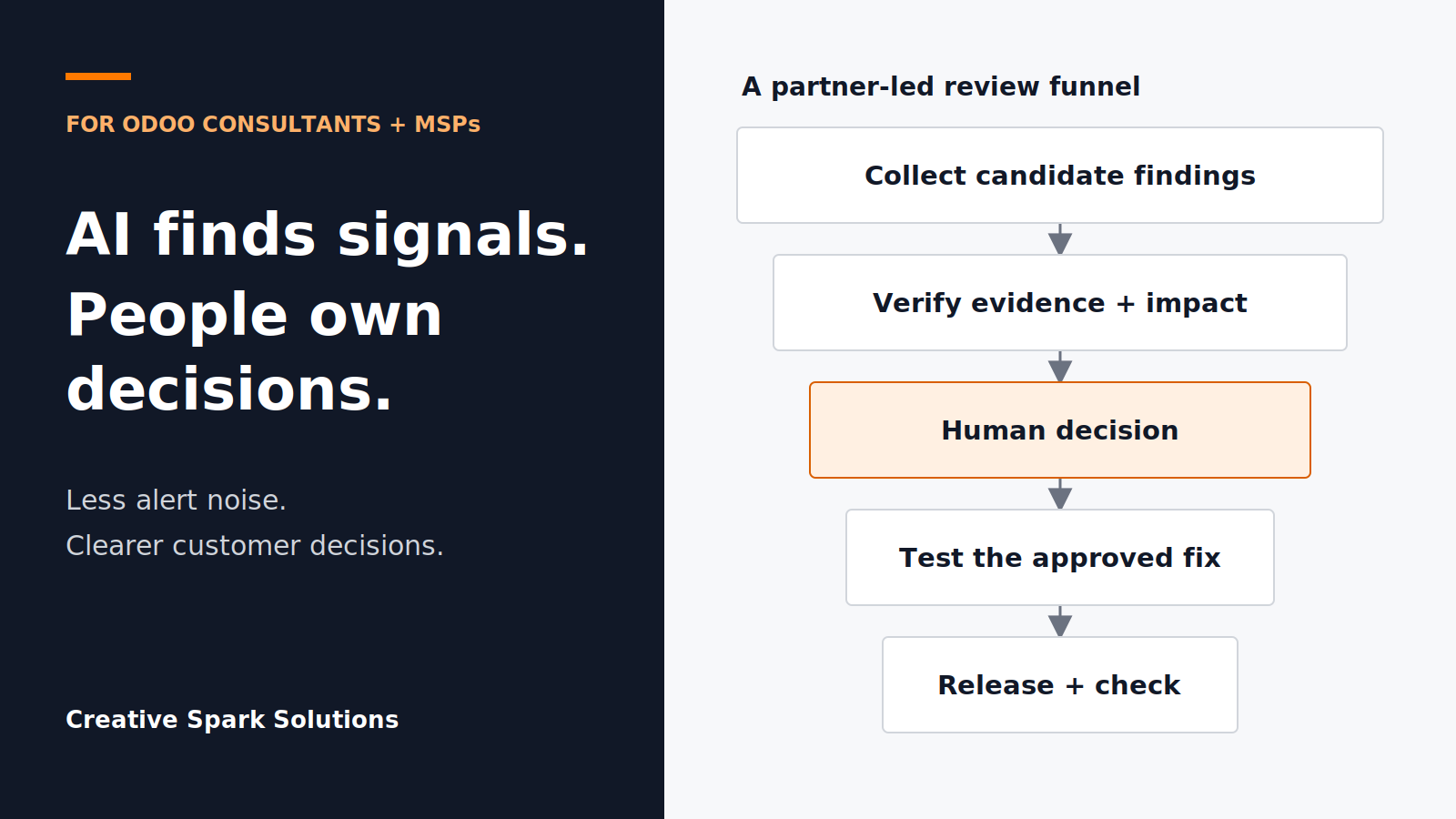
A practical funnel looks like this:
- 1. Scope the review. Name the application, source revision, included files, exclusions, and customer rules. Run on agreed changes or a documented cadence; do not imply coverage that is not configured.
- 2. Collect candidate findings. Combine AI observations with existing tests and scanning tools. Keep the evidence and distinguish a suspected problem from a reproduced failure.
- 3. Verify and prioritize. Remove duplicates, investigate false alarms, and connect each confirmed issue to a business impact. A missing approval check matters differently from a formatting suggestion.
- 4. Put a decision in human hands. Give a named reviewer the evidence, affected workflow, proposed change, test plan, and recovery plan. Record approval, rejection, or an explicitly accepted exception.
- 5. Test, release, and verify separately. Test approved changes away from the live system, release only the authorized version, and check the actual result. Keep review findings, approvals, and deployment receipts distinct.
Human review is not a substitute for technical controls. OWASP’s guidance on excessive agency recommends limiting tool functionality and permissions, enforcing authorization outside the model, and requiring approval for high-impact actions. The system should refuse disallowed operations even when the model asks for them.
GitHub’s responsible-use guidance also describes the limitations of AI review, including false findings. The human filter must be able to challenge the report—not just click Approve.
Make the service tangible before making it recurring
Start with one customer, one important workflow, and a bounded review. A useful deliverable is a short decision packet: what was reviewed, confirmed findings in business language, evidence, recommended actions, named owners, and unresolved limits.
If ongoing review proves useful, agree on triggers, coverage, response expectations, exclusions, and who can authorize changes. Separate review work from remediation and release. Measure confirmed issues addressed, noisy findings rejected, and time to an informed decision—not simply how many alerts the AI produced.
NoodleNet’s operating-model approach connects knowledge, tools, workers, and human oversight. The screenshot makes one piece concrete: AI can help inspect the work while leaving changes under human control.
The offer is not “AI watches your code, so you can stop worrying.” It is “we help you understand the risk, enforce the boundaries, and make a better decision before a change reaches your business.”
If you support Odoo customers or manage technology for smaller businesses, schedule a Spark Session. Bring one integration, customization, or repeated support problem. We can map where AI review could help, which guardrails belong in the system, and where your team’s judgment adds the most value.